|



| Want to see this page from the opposite viewpoint? Click here -> |

|
|
There are a lot of words in Japanese which describe concepts missing from English, and likewise
some concepts available in English missing from Japanese. (Although it seems to me that English
has a lot more gaps than Japanese.)
Be warned : discovering concepts which can't be expressed in your own language can lead to serious headaches! |
Words missing from English:
|
Genki
:
healthy, full of life and enthusiastic
Usage:
"The students in class 2-1 are so genki that it's always fun to teach them."
Describes a general lively enthusiasm (although not for anything in particular) and bouncy
cheerfulness. Genki children are great fun but have a tendency to knock things over and do
themselves injuries.
|
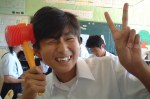 A genki student | ||
|
Yappari
:
Just as could have been predicted from the information available beforehand
Usage:
"Yappari it was foolish of me to expect England to win the World Cup."
A word for acknowledging regretfully that the predicted outcome has occured, even if
nobody had actually BEEN predicting it. Can be used on its own to express smugness that
something has gone wrong for someone, just as you'd expected it would.
| |||
| Bimyo : not really one thing or the other; halfway between the two options | |||
| |||
|
Dame
:
no good, unacceptable
Usage:
"The weather has been dame all week."
This can be used in virtually any situation where something can be thought of as no good, from
refusing permission for something or explaining that something is not possible to complaining
that your pen doesn't work.
| |||
|
Asobu
:
play
Usage:
"Why don't we asobu this weekend?"
How is this a missing word when we have 'play' in English, I hear you ask. Well, have you ever
asked your colleagues or your boss around to play? (I'm assuming not, but each to their own.)
In English, adults do not play. Well, clearly they DO, but they insist on strenuously avoiding
the word in case someone should tell them that they ought to be doing something useful instead.
This means that in English you always have to specify WHAT you're suggesting beforehand, even
if it's only to 'have a cup of tea', whereas in Japanese you can just say "let's asobu" and
leave making an actual plan to the other person.
| |||
|
Ganbaru/ganbatte
:
try particularly hard, do one's best
Usage:
"I feel ill but I'm going to ganbaru and go to work tomorrow anyway."
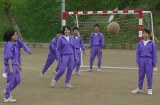
To ganbaru is very important in Japan and this word is used a lot, particularly as 'ganbatte', an
instruction to do your best or try hard. In Japanese this is used to encourage people or cheer
them without implying that they aren't already doing so, when in English we might find it rather
patronising to be told to do our best many times a day, as though we could be doing better if
only we put a bit more effort in. Also, 'doing your best' in English is generally associated with
failure, whereas 'ganbaru' can be used whether you succeed(ed) or not.
|
 A Japanese volleyball player ganbaru-ing | ||
|
Mendokusai
:
requiring more effort than the outcome would justify
Usage:
"I studied a bit of Chinese but it was too mendokusai so I gave up."
A very useful word for complaining about things that someone else has told you to do.
| |||
|
Wa
:
a state of peace and harmony due to everything being in its proper place
Usage:
"There was a strong sense of wa within our group."
Creating and maintaining wa is a fundamental part of Japanese life. It keeps society stable and
peaceful but also explains why things change so slowly in Japan - nobody wants to disturb the wa
by suggesting new things. | |||
|
Ichio
:
not to the preferred extent but to a sufficient degree that it can't be denied
| |||
| |||
|
Urusai
:
unwanted noise
Usage:
"My manager is really urusai"
Urusai can mean simply 'noisy' in the sense of making a loud sound, but just as often it can
refer to someone saying things that you don't like. It can even be used as an outburst meaning
'I'm hearing things that I don't want to be hearing', or in other words: 'shut up!'
| |||
Words missing from Japanese
|
Nothing Probably not surprising that this word doesn't exist, since having a word to describe an absence of anything seems a bit eccentric in itself. | |
|
Funny We have enough trouble with funny-strange and funny-haha in English, but there really doesn't seem to be any way to accurately describe funny-haha in Japanese. To describe comedy you'd simply talk about something that was strange and interesting. The quality of being 'funny' doesn't have it's own concept. Not that Japanese humour isn't funny, of course, although it can from time to time veer to close to simply being strange and forgetting about the haha. | |
|
You In Japanese there are numerous different words that mean 'you', but you're very rarely allowed to use any of them. Generally speaking, you have to refer to the person you're speaking to by their name, assuming of course that you know the right title to attach to it (san, sensei etc.). If you don't know both someone's name and their title then the only solution I can see is to avoid talking to them altogether. | |
|
Less The word 'more' exists and is used a lot, but for some reason it has no opposite in Japanese, perhaps due to some administrative oversight. | |
|
Blue There are only three primary colours of light and, amazingly, the Japanese have given the same name to two of them. Blue and green are both known as 'ao', although green does have another name which is used for certain things, just to avoid confusion. The sensible thing to do would be to use this word for all green things, but most things are already stuck being ao. Hence there is no contradiction between having ao apples and the ao sky. This also explains why traffic lights in Japan are often blue, which is fine for the Japanese because they know that the 'go' light is supposed to be ao, but doesn't half confuse foreigners.
| |
 Ao |
 Ao |